

Energy Drink Market Trends, Growth and Growth Rate in 2022
Although you would think energy drinks companies would be suffering, because of the sugar tax as well as the Covid-19 pandemic, the opposite has been true.
While gyms were closed due to lockdown, people continued to work out at home and outside, which meant the sports drinks and energy drinks industry continued to thrive.
In the following post, we outline some of the key developments in this progressive and growing industry, looking at the real winners and some of the key market trends for the future.
[lwptoc]
How much is the energy drink market worth?
In 2020, global energy drinks sales had reached a staggering $57.4 billion.
This is amazing when you consider it was valued at about $43 billion in 2016 and $53.01 billion in 2018.
There is a lot of love for energy drinks among consumers, love that is showing no signs of dying off.
Is the energy drink market growing?
Yes, it is continuing to grow – you only need to look at the numbers above to understand that.
And when you consider that it is expected to reach a value of $86.01 billion in just 5 years in 2026, meaning it will have experienced a compound annual growth rate of around 7.20%, energy drinks are unlikely to disappear any time soon.
NEED HELP BRINGING YOUR NEW ENERGY DRINK TO MARKET?
Our food and beverage marketing agency can help
Contact the Greenseed team today for a chat about your goals and let’s use our network to help get your product in front of a huge audience.
What are some upcoming energy drink market trends?
With the energy drinks market continuing to garner interest and experiencing constant growth, interesting times lay ahead.
Whether you are interested because you are actively involved in the energy drinks market, or are just idly curious about it, we’re sure you’ll appreciate the next part of this post.
In it, we are going to look at some of the biggest trends in the global energy drinks market.
The Big Three Brands Lead the Pack
Within the global energy drinks market, three companies are more popular than others.
Even if you didn’t know the numbers, you already hit upon the companies, because it is the most obvious top three energy drinks – Red Bull, Monster and Lucozade.
So, even though there is Rockstar from AG Barr and various other contenders to the throne, the almighty three are holding their own and it’s unlikely any of the smaller brands will break through to the upper echelons of the energy drinks market.
Innovations in Flavours Is Crucial
To the casual consumer, it may not seem like there was much innovation going on in the energy drinks market.
However, the reality is that’s simply not true, as there are more varieties and different flavour combinations and twists being released than there ever has been in the past.
Consider some of the following intriguing flavours as evidence of this trend.
For instance, there’s the Watermelon and Strawberry Cooler Lucozade Blast or Monster’s innovations ranging from the zero-calorie Ultra Blue collection of flavours to the Pipeline Punch offers.
Whereas Red Bull recently introduced the Coconut Berry variant to the existing group of flavours.
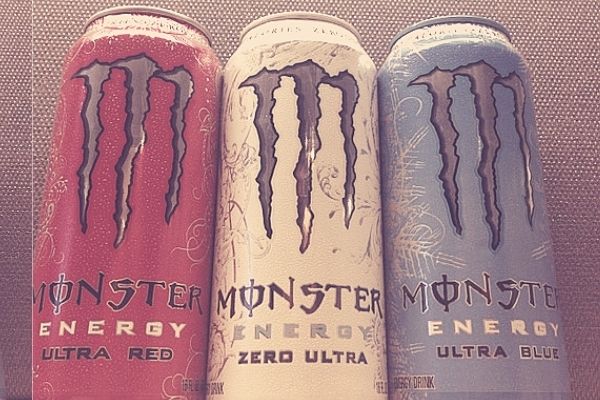
Monster are also constantly expanding their Ultra range to include more and more exotic flavours.
Natural Energy is a Thing and Growing
When you think of energy drinks, you almost certainly think of high sugar content in the form of glucose or a specific synthetic alternative.
That’s very true with the bigger brands, but in recent years there has been a surge of smaller brands that have been gaining traction in the industry and capitalising on the public’s increased health awareness.
This is thanks to their natural ingredients and natural energy claims. These companies are now very much marketing energy drinks as health drinks too.
Purdey’s is just one example, as is Runa, made by Vita Coca, which derives its energy from the guayusa super leaf and Yusa which relies on the same natural ingredient for its energy-giving properties.
Diet Energy Drinks Are Behind Much of the Growth
We already noted that despite all the issues that could stack up against energy drinks, such as the sugar levy and the Covid-19 pandemic, sugary energy drinks are still making gains.
The interesting thing is, though, that while diet drinks only account for a smaller section of the market, they are the products that are actually behind much of the overall growth of energy drinks.
Their value has shot up over the last year or so by 16%.
It’s innovations from the teams at Red Bull, Monster (with their popular “Ultra” range) and other leading brands that have played a big part in that number and increase.
Health concerns and therefore, health consciousness is very much trending and calorie-free/sugar-free energy drinks are capitalising on this.
Who is the target market for energy drinks?
As you may have guessed from their packaging and wilder flavour innovations, the obvious targeted market is generally teenagers and young adults, between 18 and 34 years old.
We’re not suggesting there is no interest from other age groups, but the majority of people who help keep the global energy drinks market afloat are the younger generations.
Who sells more Red Bull or Monster?

Do you know some people who love Monster more than they love Red Bull?
It happens, however, despite the best efforts made by the team behind Monster to position it ahead of close rivals, Red Bull, the original and, what many people would call, the best energy drink remains on top in terms of sales figures.
That is, of course, subjective since Monster isn’t very far behind as you’ll find out below.
How much market share does Red Bull have?
As of 2020, Red Bull had a very strong 43% of the global share of the energy drinks market. With Red Bull and Monster accounting for a whopping 82% combined market share of the global market.
What is the top-selling energy drink?
It’s no surprise, when you consider the market research findings and answers to the above questions, that the original Red Bull is the best selling energy drink.
Top 10 Selling Energy Drinks in the World
- Red Bull – (Austria)
- Monster
- Red Bull – (Thailand)
- Rockstar – (Pepsi-owned)
- Eastroc Super Drink
- Hi-Tiger
- Lucozade
- NOS (Monster-owned)
- Oronamin
- Burn
NEED HELP BRINGING YOUR NEW ENERGY DRINK TO MARKET?
Contact the Greenseed team and let’s use our food and drink PR network to help your product reach a massive audience.
RESOURCES:
https://www.investopedia.com/articles/investing/022315/energy-drinks-industry.asp
https://www.grandviewresearch.com/industry-analysis/energy-drinks-market
https://www.prnewswire.com/news-releases/the-global-energy-drinks-market-size-was-valued-at-53-01-billion-in-2018–and-is-expected-to-grow-at-a-cagr-of-7-20-to-reach-86-01-billion-by-2026–300899836.html
https://onlinelibrary.wiley.com/doi/pdf/10.1111/j.1541-4337.2010.00111.x#:~:text=The%20targeted%20demographic%20group%20is,%2C%20herbal%20extracts%2C%20and%20vitamins.
https://www.t4.ai/industry/energy-drink-market-share